While reading All's Well That Ends Well, I was struck with just how familiar Paroles's arguments about virginity sounded. And, in fact, despite his less-than-upright character, I have to admit that I liked (parts) of what he was saying, if only for the humor he presents.
Let's start with Helen's question: "Man is enemy to virginity: how may we barricade it against him?" (107-108). Instead of a consensual act between two parties, sex here is clearly depicted as an assault upon a woman's honor by a lustful man. Problem number one. Virginity is put upon a pedestal; a woman who has her virginity intact is pure, clean, and desirable, and as soon as she loses it, she is ruined. We've all heard it before.
With that in mind, I found Paroles's answer to be particularly hilarious. He says "there was never a virgin got till virginity was first lost" (121-122), and that "To speak on the part of virginity is to accuse your mothers, which is most infallible disobedience" (128-129).
Paroles makes me laugh here, because what he says is so true. Virginity in Shakespeare's day was idolized; a woman's entire worth depended upon her chastity (remember Lavinia?). Today, while a woman isn't completely valued based on the status of her virginity, it is still of the utmost importance. I like what Paroles says because his tongue-in-cheek comments ring true. The concept of virginity as a means to value and devalue women is ridiculous. On the most visible level, if all women strove to preserve their virginity, humanity would cease to exist. Sex, as Paroles points out, is not only natural; it's common. Every mother was once a virgin, yet we don't denounce our own parents as whores.
Though I don't agree with Paroles's main point, that women should have sex solely to procreate, I do appreciate a Shakespearean voice denouncing the value of the protected virginal status. Somewhere hidden in his snarky humor and off-the-cuff remarks lies a real argument against the practicality of coveting a woman's virginity, and that is something I can agree with.
Showing posts with label virginity. Show all posts
Wednesday, February 25, 2015
Leave Her Virginity Alone
Being the only child of a well-known doctor, people can assume that Helena in All’s Well That Ends Well is a well-educated woman with some background in her late father’s profession. But even with this assumption, boys Helena’s age only value her on the basis of her sexuality:
“Your date is better in your porridge than in your cheek, and your virginity, your old virginity, is like one of our French withered pears: it was formerly better, marry, yet ‘tis a withered pear (1.1.145-9).”
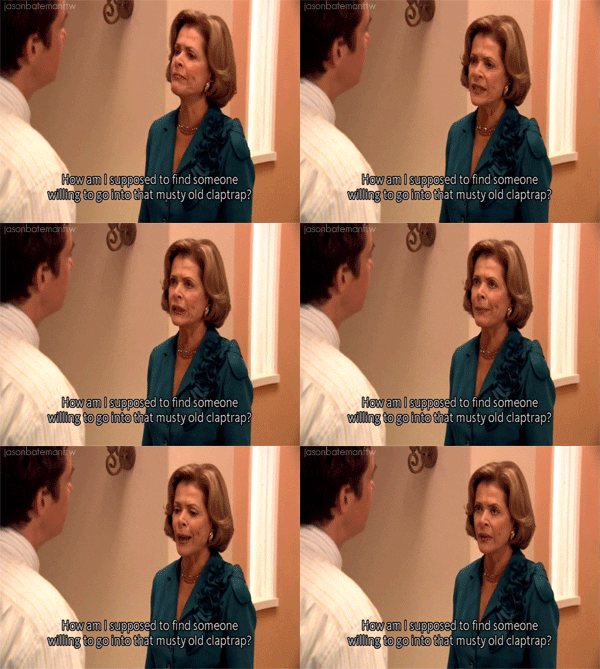
This metaphor towards her virginity has the same crudeness as a conversation in Arrested Development between Michael and his mother Lucille:
“Michael: It [the family cabin] is going to be up in Tahoe a couple more days. Maybe you could take a date.
Lucille: How am I supposed to find someone willing to go into that musty old claptrap?
Michael: [Long awkward stare] The cabin… Yes! That would be difficult, too.”
Both scenarios refer to the vagina as a horrid and vile part of the female anatomy. But no one expresses this unsavoriness when it’s associated with reproduction and furthering of a man’s name throughout generations:
“Out with’t [virginity]! Within t’one year it will make itself two, which is a goodly increase, and the principal itself not much the worse (1.1.136-8).”
Ohhhh, now I get it. When a baby is the end product the vagina is not so bad, but any other function that’s necessary for the good health of the woman, and for reproduction itself, then it’s condemned. Helena’s is horrid because she refuses to give it up. Lucille’s is vile because she’s an older woman and no longer fertile. Makes complete sense.
But here’s what kills me about this logic, it creates this idea that women should be ashamed to talk about any other biologically natural function of the female body. Female sexuality is only positively spoken of when in it’s toward something societally desirable. Any cramps, pain, itching, keep that stuff private. And no, it’s not the most pleasant topic, but why should I keep my own “victoria” a secret when men can openly make references to their “disco stick”? And, bringing it back to the literature, why must Helena’s virginity be condemned when she exercises full possession of her sexuality by deciding to save it for what she determines as the right time? Preferably, when Bertram and her consummate.
Helena is right to stand by her virginity. She has the right to hold onto to her virginity without it being called a “withered pear”. And even though she receives harsh critiques, she creates a plan to use her intelligence and medical background knowledge in order to gain what she wants and uses her femininity with power and respect. She saves the King and she marries Bertram on her own terms. Helena shows true feminine power. She shows that a woman can use her intelligence and doesn’t need to compromise her sexuality to get what she wants.
![]() |
| Wow...A "withered pear"? Thanks. |
This metaphor towards her virginity has the same crudeness as a conversation in Arrested Development between Michael and his mother Lucille:
“Michael: It [the family cabin] is going to be up in Tahoe a couple more days. Maybe you could take a date.
Lucille: How am I supposed to find someone willing to go into that musty old claptrap?
Michael: [Long awkward stare] The cabin… Yes! That would be difficult, too.”
Both scenarios refer to the vagina as a horrid and vile part of the female anatomy. But no one expresses this unsavoriness when it’s associated with reproduction and furthering of a man’s name throughout generations:
“Out with’t [virginity]! Within t’one year it will make itself two, which is a goodly increase, and the principal itself not much the worse (1.1.136-8).”
Ohhhh, now I get it. When a baby is the end product the vagina is not so bad, but any other function that’s necessary for the good health of the woman, and for reproduction itself, then it’s condemned. Helena’s is horrid because she refuses to give it up. Lucille’s is vile because she’s an older woman and no longer fertile. Makes complete sense.
But here’s what kills me about this logic, it creates this idea that women should be ashamed to talk about any other biologically natural function of the female body. Female sexuality is only positively spoken of when in it’s toward something societally desirable. Any cramps, pain, itching, keep that stuff private. And no, it’s not the most pleasant topic, but why should I keep my own “victoria” a secret when men can openly make references to their “disco stick”? And, bringing it back to the literature, why must Helena’s virginity be condemned when she exercises full possession of her sexuality by deciding to save it for what she determines as the right time? Preferably, when Bertram and her consummate.
Helena is right to stand by her virginity. She has the right to hold onto to her virginity without it being called a “withered pear”. And even though she receives harsh critiques, she creates a plan to use her intelligence and medical background knowledge in order to gain what she wants and uses her femininity with power and respect. She saves the King and she marries Bertram on her own terms. Helena shows true feminine power. She shows that a woman can use her intelligence and doesn’t need to compromise her sexuality to get what she wants.
Tuesday, February 24, 2015
V-Card Controversies
PAROLES:
Are you meditating on virginity?
HELEN:
Ay…. Man is enemy to virginity: how may we barricado [barricade] it against
him?
PAROLES:
Keep him out.
(lines
105-109)
All’s
Well that Ends Well explores interesting angles on the concept of
virginity, specifically in the dialogue between Paroles and Helen in Act I,
Scene 1. There are several conflicting views shared between the two characters,
and it feels as though what is expressed possibly reflects the views of
Shakespeare at the time as well.
Paroles and Helen begin their
conversation comparing the concept of virginity and sex in general to that of
war. Phrases like “barricado” (lines 107-108) and “military policy” (line 115)
all use war as a metaphor for virginity: Helen asks Paroles for advice on how
to keep her virginity away from unwanted lovers, and even admits a woman’s
virginity needs a man’s help, apparently.
HELEN:
…our virginity, though valiant in defence, yet is weak. Unfold to us some
warlike resistance.
PAROLES:
There is none. Man, setting down before you, will undermine you and blow you
up.
(lines
110-113)
Basically, there’s no hope for women
at this period in history in deciding when and where they decide to “lose” their
virginity (which, the concept of “losing” your virginity is a bit strange to me—but
none on that currently). In fact, just a bit later in the scene, Paroles urges
Helen to “lose” her virginity so she can contribute to the increase in
population because keeping her virginity makes her potential for reproducing “lost”
(line 124). Here again is the concept of “losing” and also a strange,
conflicting view in which Helen is encouraged to “lose” her virginity but only
to be in line with the patriarchal, archaic view that Paroles offers, that of
to bring children into the world. However, it can be said that it is still
strange Helen would even be encouraged to lose her virginity at all. Wasn’t it
prudent to most people back in the time Shakespeare wrote in to preserve a woman’s
virginity is one of the most important things? We see in Titus Andronicus that Lavinia is considered to be “nothing” or “ruined”
once she is raped and her virginity is stolen from her. Why the slight
deviation in All’s Well, where losing
virginity is considered to be a better than keeping it, if only for the aspect
of producing offspring?
Moreover, Paroles calls virginity “peevish,
proud, idle, made of self-love—which is the most inhibited [prohibited] sin in
the canon [scriptures]” (lines 134-136). So now virginity is considered a sin,
when most religious texts preach the sanctity of it. Why has Shakespeare
expressed such a different view on virginity in this play and not in the
others? Possibly, this is a new interpretation of his developed over the years
as he continued to write plays. That being said, this play feels neither
comedic nor tragic in nature, but just bizarre in its material, almost like
Shakespeare was going for something quite prematurely absurdist.
Back to v-cards. Helen asks Paroles,
“How might one do, sir, to lose it to her own liking?” (line 140). She wants to
“lose” it on her own terms, but Paroles ignores this tender request by relating
virginity to being sold: “Off with’t while ’tis vendible [salable]” (line 143).
This, like all Shakespeare plays, objectifies women and paints their virginity
as an object to be sold. Is Shakespeare really pushing for women to make their
own decisions regarding their virginity or really just reinforcing gender roles
of the time? I’d like to end with one more quote, at the very end of the scene.
It feels, once again, this quote can both objectify Helen and women in general,
but also hints at their little agency in being able to manipulate their
husbands, perhaps. Whatever the meaning, Shakespeare has some controversies on
virginity he never tied up. What do you all think?
PAROLES:
…Get thee a good husband and use [treat] him as he treats thee. So farewell.
(lines 197-198)
Labels:
All's Well that Ends Well,
Helen,
Paroles,
sexuality,
virginity
Subscribe to:
Posts (Atom)